CI/CD
At a high level, the VOL application's CI/CD pipeline can be visualised as follows:

Continuous Integration (CI)
Only parts of the application that have changed are updated during continuous integration.
The CI workflow is triggered by a pull_request to the default branch (main). The workflow is responsible for building, testing the application & infrastructure, and running Terraform plans on the infrastructure.
Workflow: .github/workflows/ci.yaml.
Various tools run on CI to ensure the quality of the codebase:
 PHP
Testing
Linting
Security
 Docker
Linting
Testing
- Docker build (
docker build)
Security
 Terraform
Linting
- TFLint
- Terraform format (
terraform fmt)
Testing
- Terraform validate (
terraform validate) - Terraform plan (
terraform plan)
Security
PHP checks
php.yaml (the apps) and php-lib.yaml (the libraries under lib/) run the
unit tests, PHP_CodeSniffer, Psalm and PHPStan. CI, CD and branch deploys all
call them, so the choices below apply to all three.
How the jobs are laid out
Every job spends about 25 seconds on setup before it checks anything: checking out, installing PHP, restoring Composer's cache and installing dependencies. A check only gets a job of its own when it takes much longer than that. Otherwise the extra setup costs more than running the check alongside the others.
| Project | Jobs | Why |
|---|---|---|
| api | Test · PHPStan · PHP CodeSniffer · Psalm | The tests, PHPStan and Psalm take 30–60s each. phpcs takes about 15s, but added to any of the other jobs it would make that job as long as Psalm's, the longest in the app. |
| selfserve, internal | Checks | Each check takes 2–20s. |
| olcs-common | Psalm · Test, PHP CodeSniffer, PHPStan | Psalm takes about 45s; the others 3–10s each. |
| Other libraries | Checks | All four checks together take under 30s, and under 10s for most. |
The workflow picks the layout from the project name, rather than the caller passing it in, so CI and CD cannot drift apart.
Within a job, each check is its own step and runs even if an earlier one failed, so a failing test cannot hide a phpcs or Psalm failure.
If a check in a shared job grows well past the setup time, give it a job of its own by changing that project's entry in the workflow's matrix. If a check in a job of its own shrinks to a few seconds, move it back in. Each job's step list on the Actions page shows how long every check took.
There is no job that warms Composer's cache first. There used to be, and every check waited about 35s for it, but each job already restores the cache itself.
Parallelism within a check
- PHPStan runs a worker per core by default.
- Psalm uses every core locally but drops to one thread when it detects CI,
so the workflows pass
--threadsand--scan-threadswith the runner's core count. That took the api's Psalm from about 95s to about 60s. - PHP_CodeSniffer cannot detect the core count, so every ruleset sets
<arg name="parallel" value="16"/>, deliberately more than most machines have cores. phpcs splits the files into that many equal-sized batches up front and waits for the slowest, rather than handing files out as workers free up. Each batch has the same number of files but not the same amount of work. With 10 batches of the api, the slowest took 7.4s and the quickest 1.1s, so most cores sat idle at the end. With 16, the slowest batch is 5.6s, and the operating system gives the slow batches the cores the quick ones free up. On a 10-core laptop the api took 11.5s with 10 workers and 9.7s with 16. More workers gain a second or so (8.5s with 32), and on a 4-core CI runner the cores are the limit anyway: about 44s of sniffing over 4 cores. Compared with no parallelism, it took the api's phpcs in CI from about 48s to about 15s. - Unit tests run serially, in random order, on purpose. See why CI stays serial.
Only the bigger code bases gain from any of this. Measured on a laptop with 1 and 4 workers, olcs-common's Psalm went from 95s to 29s and its PHPStan from 66s to 14s, and olcs-transfer saved a few seconds. The four small libraries' checks take a few seconds whatever the worker count.
Continuous Deployment (CD)
The CD workflow is triggered by a successful merge to the default branch (main). The workflow is responsible for building and deploying the application through to the production environment.
To view the current version of the application in each environment, refer to the deployments page.
Workflow: .github/workflows/cd.yaml.
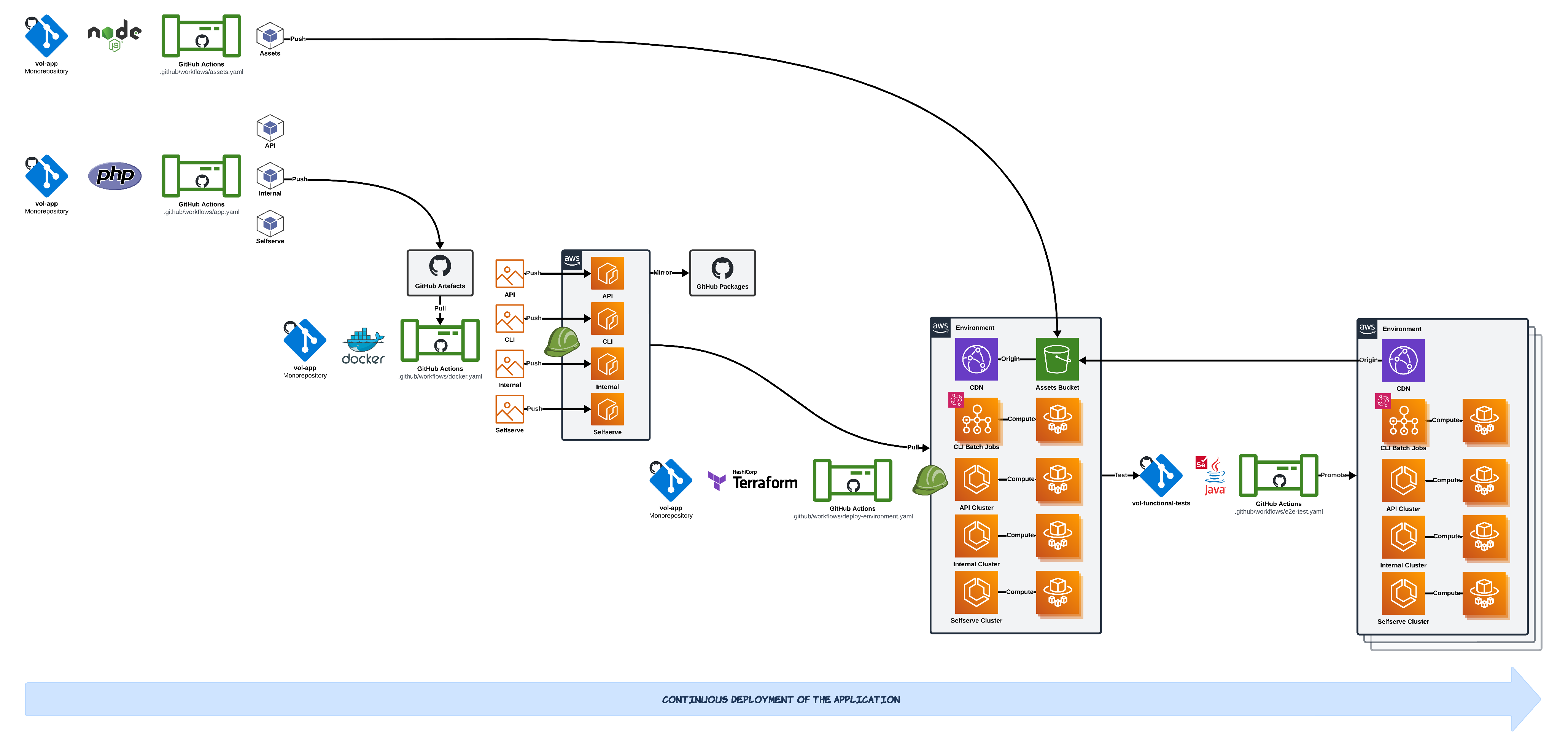
Path to production
Environments
The VOL application has four environments: Development, Integration, Pre-production, and Production. Each environment has a specific purpose and stability level.
The stability is only as good as the test coverage that assures it. For example, integration tests are only as good as the E2E tests that assure that it's working.
| Environment | Abbr. | Purpose | Stability | Test coverage provided by |
|---|---|---|---|---|
| Development | DEV | Used by the team to test their changes. | Unstable | Continuous Integration (CI) |
| Integration | INT | A stable environment assured by the E2E tests. | Stable | End-to-End (E2E) tests |
| Pre-production | PREP | Used to test the application in a production-like environment. | Stable | Release tests |
| Production | PROD | The live environment. | Stable | User Acceptance Testing (UAT) |